You can do this!
You can do this !
Most people seem to doubt that they have the 'hearing skills' required to play music by ear.
Playing by ear appears to be magic—an inexplicable phenomena—therefore, an unattainable ability. But If you can speak, and can distinguish between a barking dog and a crowing rooster, I believe that you possess the required hearing skills to play by ear.
Anyone who has learned to speak has a proven ability to recognize subtle differences in sounds, learn a meaning for these sounds, and reproduce them with all their subtleties in an appropriate context.
What most people don't have, students and teachers alike, is a common vocabulary to discuss the process of playing a musical instrument 'by ear.'
It seems a bit counter-intuitive, but that vocabulary is basic music theory.
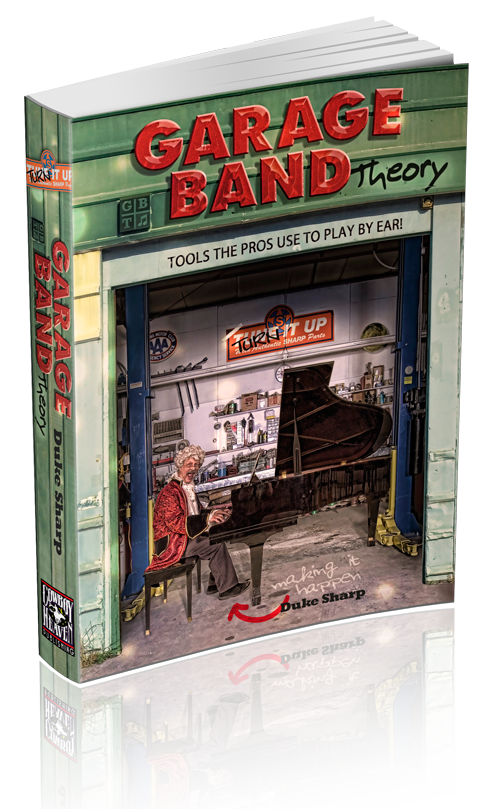
Garage Band Theory clearly presents essential vocabulary with the specific goal of helping you learn how to figure out your favorite songs by ear. And with loads of examples and illustrations for guitar, mandolin, banjo and keyboards, GBT shows you how to apply that ability to all instruments.
Music theory is a vast topic, but I came to realize that there are only a few definitions and concepts that are required to understand a process for playing by ear. Garage Band Theory approaches these essential definitions: counting, notes, intervals, scales, chords, keys, progressions and melodies. Anyone who thoroughly understands these words (which apply to all instruments) can comprehend the structure of pop songs, and when you combine relevant knowledge of the structure of popular music with your natural ability to recognize sounds, you're well on your way to playing by ear.
There's a phenomenon that every musician who has played weddings has witnessed: when the band starts, the little kids start heading for the noise. If left unrestrained, there will soon be a bunch of babies on the dance floor, grinning like maniacs, bobbing and twitching around, doing these hysterical, spontaneous gyrations. Often they're too young to even have the word 'dance' in their vocabulary, but they start doing it anyway.
This primal attraction/connection to music seems to be built-in to the human animal, and it's more than likely that includes you.
You have the hearing skills, you have the attraction, you just need to learn the language. It's not even very hard, it just takes time. Why not start now?
Whether you're a vocalist or a drummer, play guitar or trombone,
Garage Band Theory will help you communicate with the band
and let you think conceptually about your music.
Everyone uses the same words, and all the important ones are here!